


Do you want to know a secret test-taking tactic that can save you 10, 15, or even 20 points on an exam or quiz?
If so, keep reading because I can teach you how to use this tactic to save you those points on an exam or quiz. I will go over:
- What it is;
- Why it works; and
- How to implement it.
Let’s get into it!
What Is This Tactic?

This tactic is called writing down the information in the question.
What do I mean by this?
When you are given a question, you are given information. When reading this information, there is a chance you might do one of two things (or both):
- Overlook something; or
- Misinterpret something.
This tactic can help you fix that.
This tactic can help you prevent this.
What you’ll do is you will look at the question, read the question, and write down all of the information associated with the question when you are working on the question.
I will show you how to do this later in this post. If you want to get right into that, head over to the section of the post titled “How To Implement This Tactic.”
When you do this, the information in the question will be ingrained in your head instead of you overlooking something or misinterpreting something you read.
This is a mistake I made many times in my undergraduate career, which resulted in me earning lower exam scores than I had anticipated.
Although the grades in these classes were not affected, the mistake was something I saw that needed to be corrected to prevent my grades from tanking unnecessarily.
This was especially important since test scores counted for a huge portion of my grades in each class.
Hence, I had to get it fixed!
And I did.
Through trial and error, I came up with a way to minimize, and sometimes eliminate, overlooking information and misinterpreting information on questions that show up on exams.
If you read to the end of this post, you will know how to execute this tactic to ensure you are reading questions properly on exams.
Why Does This Tactic Work?

In short, this tactic works because you write down the information instead of skimming the information.
When you write down the information in the question, your mind tends to process the information more as a result of internalizing the information.
Studies, like the Mueller and Oppenheimer study, have proven that handwriting the things you read results in greater comprehension of that information.
In the context of learning information, this results in higher exam scores.
BUT, in the context of actually taking exams and quizzes, handwriting your notes can prevent you from losing 10-15 points on an exam just because you interpreted the information correctly.
Why put an extra risk on yourself of losing 10-15 points from misinterpreting or overlooking a point on an exam question?
Writing down information in the question can save you from a needless panic attack and needless suffering.
That is why this tactic of writing down the information in the question works to prevent you from needlessly losing points on an exam or quiz.
How To Implement This Tactic

For this tutorial, I will illustrate how to implement writing down the information for two types of questions:
- Problems You’d See in STEM Classes
- Typical Multiple Choice Questions
For other types of questions, like essay questions, this tactic applies since the idea behind the tactic is to avoid overlooking and misinterpreting information you need to know.
- Problems You’d See in STEM Classes
Let’s suppose you are given this problem to solve:
Solve the following quadratic equation without the quadratic formula.
x2+5x+6=0
The first thing you should do is write down the goal of the problem itself. Write down what they are asking for.
Goal: Solve the quadratic equation without the quadratic formula.
The next thing you should do is write this down:
Solution: Keyword: Desired Units = None
Unitless
Solve quadratic equation
WITHOUT the
quadratic formula.
x2+5x+6=0
(x+2)(x+3)=0
x= -2
x= -3
x = -2, -3
Here is an illustration of how I did this procedure:
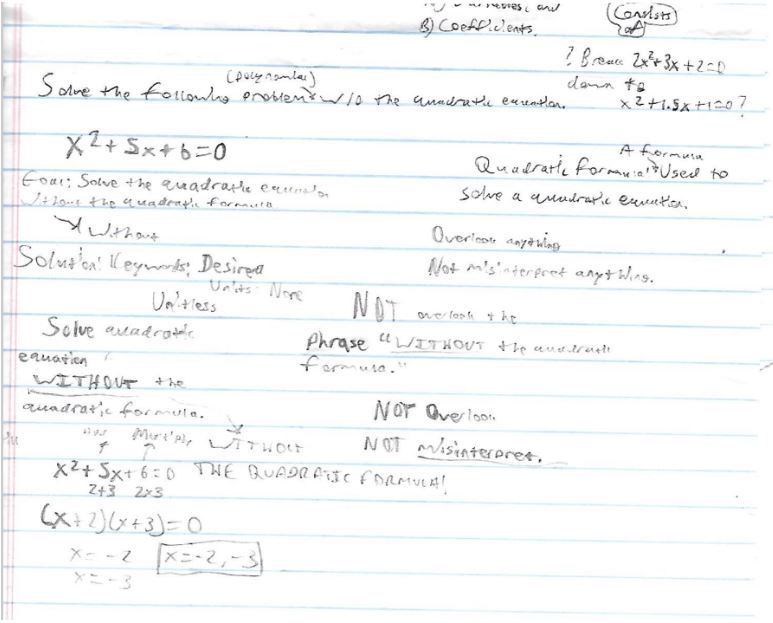
Of course, if you know how to solve a quadratic equation, you saw what I did to get the answer.
But here’s the thing:
Some students will overlook parts of the question that are important or misinterpret certain pieces of information in the question.
This can cost students a good number of points on their exams and quizzes.
To combat this problem, I wrote down the important pieces of information I needed to know. This is so I could be sure of what the question was asking me to do.
The first thing I did was I wrote down the word “without.” I stuck an arrow out of the question to point that out to me. This is an example of what I’d like to call “writing down information on the sides.”
This is the practice of taking important pieces of information in a question and writing them out so you know the pieces of information being asked in the question.
I don’t necessarily do this for every question, but it’s a handy trick that I encourage you to do when applicable.
The next thing I did, which is what I recommend you do for every problem you face on an exam or quiz, is I wrote down all of the keywords on the problem statement.
You would first write out what the desired units are because if you don’t comprehend what units you are being asked to put your answer in, you will get your answer incorrect.
That’s the first piece of information you should write down since it’s arguably the most important piece of information in the question.
If you have the wrong nits, your answer is incorrect before you’ve even started the problem.
The next thing you should do is write down any piece of information you see that your gut is telling you is important.
In this example, I wrote down “Solve quadratic equation WITHOUT the quadratic formula.”
If I didn’t write this down, I could’ve fallen into the trap of doing the problem with the quadratic formula.
Because I wrote down this piece of information, I am internalizing it and calling it out so it is to my attention that I cannot solve this problem with the quadratic formula. Otherwise, I will get the question wrong for not following instructions.
As you can see in my handwritten notes, I wrote “WITHOUT THE QUADRATIC FORMULA?” to reemphasize to myself that I couldn’t use the quadratic formula to solve the problem.
Repetition is a GREAT sales tactic and I sure use it on myself when I can to reemphasize things I can’t be overlooking.
It’s one of the best ways to not overlook something since we tend to remember things we see again. I encourage you to use this when you can!
After I wrote all of the keywords I needed to write, then I started solving the problem with the relevant information at the front of my mind.
As you can see, I solve the quadratic equation without the quadratic formula.
A lot of times, students who see a problem like this would just understand the instruction of solving the quadratic equation, but overlook the fact that the question is asking you to solve it without the quadratic formula.
They are so accustomed to solving the quadratic equation with the quadratic formula that it becomes second nature to them to solve it with the quadratic formula without asking themselves what they need to do to get the correct answer based on the question.
If you write down the information associated with the question, on the aides and the information associated with the question in as neat of a way as possible, you can avoid pitfalls that would trap students in answering any type of question asked in a STEM class.
You’ll know what you need to do, what to avoid, and what units your answer must be in without overlooking or misinterpreting any part of the question.
This is a super powerful tactic that has saved me points on exams and catapulted my grades when I found out about this trick. There were no “typos” as far as I was concerned after I found out this secret!
- Typical Multiple-Choice Question
For a typical multiple-choice question, you can follow the same methods for STEM problems, but if time is an issue, you can get away with writing information on the sides and skipping the procedure of writing the goal of the question and the whole outline I mentioned regarding keywords.
You should still write the desired units the question is asking for either way if the question is asking for a mathematical answer.
For example, let’s say you had this question here:
Who was the 16th President of the United States?
A) George Washington
B) Franklin Delano Roosevelt
C) Abraham Lincoln
D) Barack Obama
Here is a screenshot of what I would do to write the information on the sides for this question:
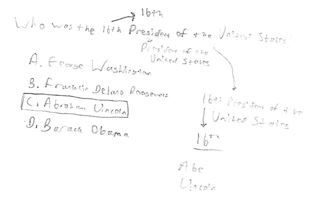
Sometimes, people would breeze through reading the question without looking at the fine details it is asking.
If you didn’t write down the information it was asking, you could’ve interpreted the question as who was the 32nd president of the United States.
If you interpreted the question that way, you would’ve gotten the answer wrong.
Hence, you should write down the information on the sides to not misinterpret anything and to make sure nothing is overlooked.
This will get you out of trouble if you use it.
In summary, use Test Taking Tactic #1: Writing Down the Information Associated With the Question to:
- Not overlook anything in the question, and
- To not misinterpret anything in the question.
If you enjoyed this post and got value from it, subscribe to this website using your email and name below. When you subscribe and confirm your email address, you’ll get a free guide called “7 Effective Study Techniques To Help You Earn The Grades You Want,” which goes over 7 study techniques you can use to earn the best grades possible.
You’ll also receive emails of the latest content published on this website. It is dedicated to giving you all the information you need to earn great grades in your classes in college and university.
Good luck on your next exam!
Evan

Evan Cruz is the founder of How To Earn Great Grades, a website dedicated to helping college students get the information they need to earn great grades in their classes in college and university.
He was featured on OnlineU and Best Colleges.
He graduated Magna Cum Laude with a Bachelor of Science Degree in Civil Engineering from Florida International University (FIU).
You can read more about Evan and How To Earn Great Grades here.