


Do you want to know a clever way to study so you can understand topics that would typically be hard to wrap your mind around?
If so, keep reading because I’ll show you the study technique you need to use for this.
This technique is called focusing on the concepts and how to do it.
The key thing to understand for this post is that there’s a difference between memorizing a bunch of facts you don’t understand versus knowing the concept that contains those facts. If you know the concept containing those facts, you can work with those facts individually and together to solve problems.
That’s the key to understanding the content behind your coursework and, eventually, solving problems in the real world.
Now, you might be asking yourself “What is a concept?”
That’s the fundamental question I will answer.
Concept = An idea that serves as the foundation for understanding:
- Thoughts;
- Principles; and
- Beliefs.
These thoughts, principles, and beliefs can be the things you are expected to know for your coursework.
Knowing the concept behind these thoughts, principles, and beliefs will allow you to use these thoughts, principles, and beliefs to solve problems (and answer exam questions).
There is a process for learning concepts I developed that I recommend that you follow.
In short, it’s this:
- Understand WHAT The Concept Is
- Understand WHY The Concept Works The Way It Does
- Understand HOW To Use The Concept
I will outline and explain these steps in this post.
Let’s go!
Understand WHAT The Concept Is

To know what the concept is, you need to know what it is.
This starts with understanding the definitions of the words involved.
Did you see at the beginning of the post that I defined the word “concept?”
You know what a concept is, right?
That’s the first step towards focusing on the concepts.
Knowing what a concept is so you know what to focus on!
Understanding what something is is the first step toward correctly classifying that thing.
It serves as the foundation for understanding what is going on.
Without defining a concept, you can’t understand why it works the way it does.
How can you understand why a concept works the way it does without knowing what it means?
It’s the foundation for understanding anything!
For instance, if you were learning about, say, compound interest, would you understand that concept without knowing its definition?
Of course not!
To understand compound interest, you must first understand its definition.
Compound Interest = Interest accumulated from an initial amount of money put into an investment and previously accumulated interest.
Would you be aware of what compound interest is based on the definition I provided?
Once you know what something is, you’ll have a better idea of what’s being discussed.
Which brings me to my next point:
Understand WHY The Concept Works The Way It Does

To know what the word why means, let’s look at its definition, shall we?
Why means “For what reason.”
Understanding the reasons for a concept being what it is is crucial for being able to manipulate the information associated with it to solve problems and to answer questions on exams without needing to memorize information that doesn’t connect in your mind.
This is the difference between simply being aware of what the concept is versus using the information associated with the concept to solve a problem.
You’d want to explore the reason for something being so. That way, you have enough evidence to believe that what is being told to you is true.
Once you seek this evidence, you will have a lot of “Aha” or “Got it” moments because you are seeing the reasons for something being so. Hence you don’t have to question what is being told to you.
You just get it.
From there, you can run with the information and use it to solve whatever problem you are facing.
Let me give you an example to show you what I mean.
Let’s say that you are learning about compound interest.
They say that the reason the concept works the way it does is because of a formula that shows money being multiplied.
Their evidence is this formula below:
F = P(1+i)n
P = Value of money today (ex. $1,000.00)
F = Value of P dollars after n compounding periods
i = Interest rate money grows per compounding period while considering the effects of compounding
n = The number of compounding periods
The person shows you that for the first compounding period (say, one year), your $1,000.00 grows to $1,100.00 using a 10% interest rate.
In the second compounding period, this person says that the $1,100.00 had grown to $1,210.00 instead of $1,200.00.
Why is this you ask?
It’s because the compounding interest formula exponentiates (1+i) by the power of n.
Simple interest doesn’t do this. Instead, it multiplies the decimal format of the interest rate by n as such:
F = P(1+in).
If you gave money 2 years to grow with simple interest, you’d get this:
F = $1,000.00(1+0.1(2)) = $1,200.00
This is the evidence as to why the concept of compound interest works the way I presented it.
Do you see how believable the concept of compound interest is after I presented the formula for it?
Do you see how compound interest grows money more than simple interest when I presented the simple interest formula?
Now you see the why behind the what and the evidence that supports the why.
You could be asking yourself “How do I use the concept to solve problems?”
That’s the next question we’ll explore.
Understand HOW To Use The Concept

Let’s look at the compound interest concept as an example.
Suppose you were interested in learning how to get rich.
You wanted to know one of the best ways to get rich.
When someone told you that compound interest can help you do this, you clicked on an article, watched a video, or picked up a book about the concept.
Eventually, you ask yourself and the presenter “How do I use this concept to get rich?”
Well, it’s simply putting as much money as possible into a growth investment like stocks to take advantage of this formula.
It’s more involved than this, but I’ll keep it basic to start.
You put in as much money as you can initially and let it grow to be as big as possible over a long period of time.
Let’s say you put $10,000.00 into an investment that pays on average 7% interest per year (the year is the compounding period).
This $10,000.00 grows into $149,744.58 after leaving the $10,000.00 in an investment that returned, on average, 7% per year. You left the money in the investment for 40 years.
The formula would look like this:
F = ($10,000.00)(1+0.07)40 = $149,744.58
It’s a pretty big jump, isn’t it?
If you are asking, $149,744.58 will not move the needle in retirement.
But, what if you put in $10,000.00 initially and then did this:
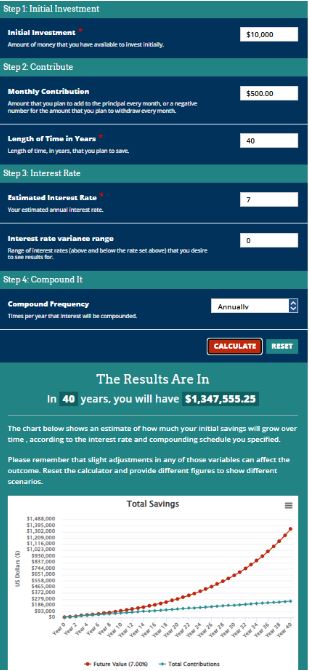
Now you’d be a millionaire!
It’s the same formula working itself over and over again.
That’s why you need to be continuously investing so you can make that formula work for you time and time again.
And if you want to take a step further:
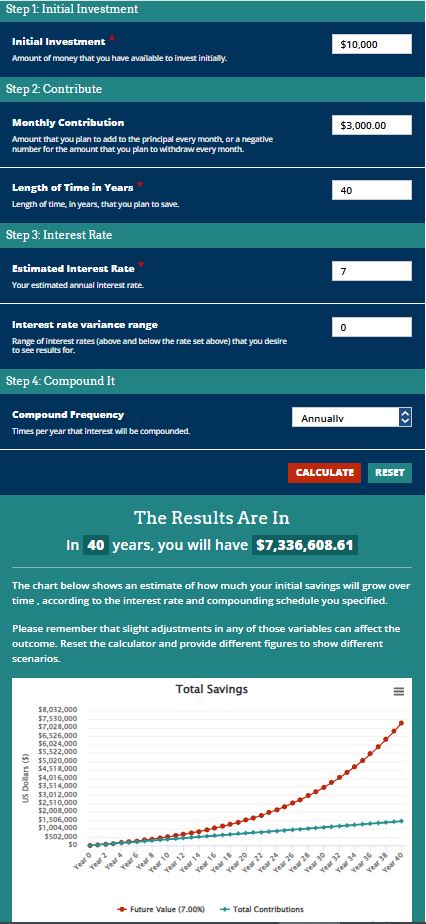
Now, do you know the
- The What
- The Why
- The Evidence supporting the why; and
- The How
behind compound interest?
Would you know how to apply the compound interest concept to ace that exam about compound interest?
I thought so!
And that’s the power of knowing the concept versus blindly memorizing everything being thrown at you.
This process works for any concept that you are dealing with.
You can manipulate information instead of relying on rote memorization to get through.
I encourage you (and challenge you) to use the information you learned in this post to master any concept you face.
You will likely have a better time acing your exams and, hopefully, have more fun learning!
If you’d like to learn all there is to know about how to earn great grades in your classes, subscribe to the email list below where, if you sign up, you’ll receive a free copy of the guide called “7 Effective Study Techniques To Help You Earn The Grades You Want.” This guide goes over 7 study techniques I’ve used and are backed by research to help you earn the best grades anyone can dream of.
I promise it’ll help you improve your studies in one way or another.
You’ll also receive free emails about content published on this website dedicated to helping you earn the best grades possible in your classes.
You’ll receive content on:
- The mindset needed to earn great grades;
- The effective study techniques that’ll help you skyrocket your grades to the moon; and
- Effective test-taking tactics proven to help you improve your exam scores (and ace them); and
- Other Things You Need To Know To Earn Great Grades.
I encourage you to sign up. Do so below with your name and email.
Happy Studying!
Evan

Evan Cruz is the founder of How To Earn Great Grades, a website dedicated to helping college students get the information they need to earn great grades in their classes in college and university.
He was featured on OnlineU and Best Colleges.
He graduated Magna Cum Laude with a Bachelor of Science Degree in Civil Engineering from Florida International University (FIU).
You can read more about Evan and How To Earn Great Grades here.